4 Types Of Footwork Into The Forehand Rear-Court Corner (Badminton Tutorial)

If you often find that you can’t get into a good position to hit the shuttle in the rear court, you might be using the wrong type of footwork! There are actually 4 main types of footwork to the forehand rear court corner alone, which we’ll be talking about below.

The 4 types of footwork to the forehand rear court corner in badminton are:

  1. Jump up or kick through (footwork for high lifts)
  2. Scissor kick (footwork for medium height lifts)
  3. Jump out (footwork for flat lifts)
  4. Late forehand (footwork for very flat lifts)

The forehand side we are referring to is on the right side of the back court for right handers, and on the left side of the back court for left handers.

The footwork you use will depend on the shot your opponent has played, so we’ll be breaking down the different footwork when retrieving high lifts, medium lifts, flat lifts, and really flat lifts when you’re taking it late.

Table of Contents

Jump Up Or Kick Through (Footwork For High Lifts)

High lifts often happen when your opponent takes the shuttle late, forcing them to play a high lift. 

Whilst this gives them time to recover, it also gives you time to get behind the shuttle and play a good quality shot. So we’d definitely recommend taking advantage of this!

How To Do The Footwork

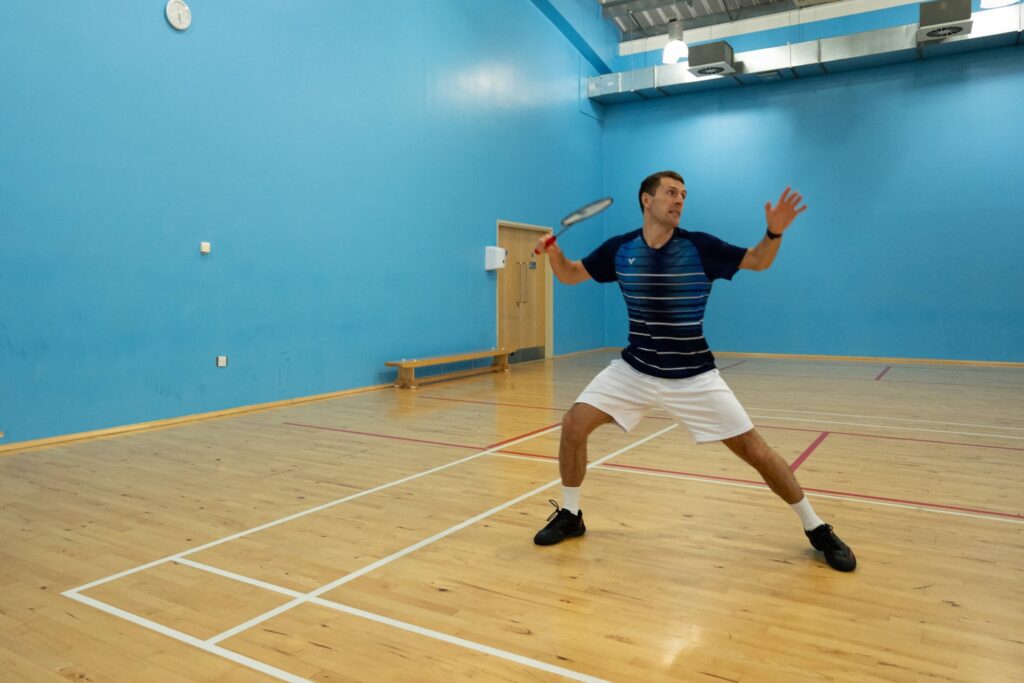
Once you know the high lift is coming (which you can anticipate by judging your opponent’s body and racket positioning), you would perform a directional split step with your racket leg behind like this:

directional split step in badminton
Directional split step to the forehand rear court corner

Then, you do a quick chasse to position yourself just behind where the shuttle is going to fall – around half a meter behind. 

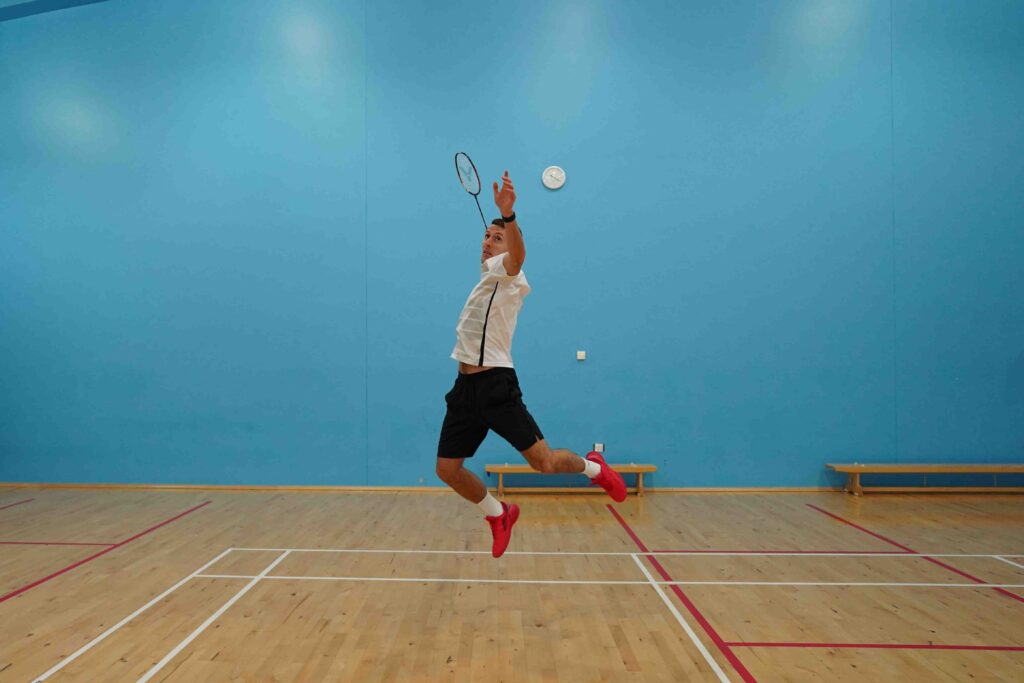
What you then do from this position really depends on whether you want to jump up or not. You can either do a two-footed jump, or kick through. 

Jumping up allows you to look more intimidating and also take the shuttle earlier, giving you a better angle on the shot. 

Whereas not jumping and instead kicking through allows you to focus more on timing and placement of your shot. Both are great options!

  • For the kick through, you load your back leg more and then bring it through as you rotate your hip through too to play the shot.
Preparation for kick through movement in badminton
Kick-through preparation
  • For the two-footed jump, you need to bring both of your legs together and then  jump up using both of your legs. This helps you get height and rotate as you hit the shot. The two-footed jump is the same as the movement for a jump smash, so we’ll link our in-depth tutorial here.

Because you’re starting behind the shuttle and moving forwards into these shots, you’ll be in a good position for the next shot which you can then take advantage of (if it comes back)!

Get Faster & More Explosive On Court

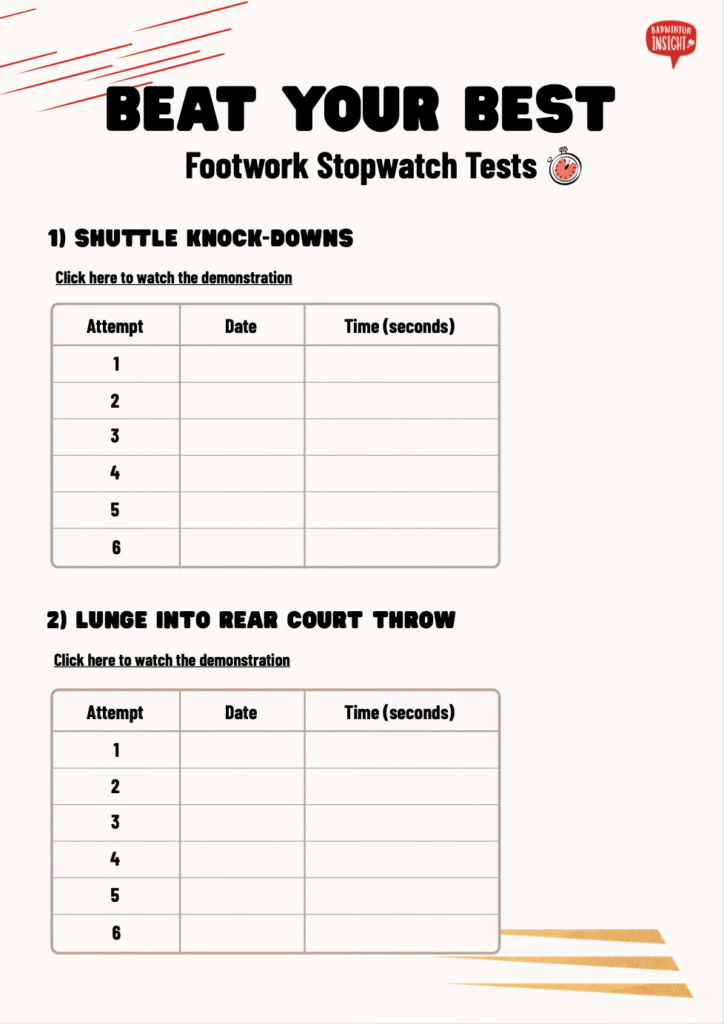
Download the free Badminton Footwork Tests PDF with 4 tests to measure your footwork speed, efficiency and explosiveness.

Then, over the next 6 days, we’ll send you some of our best footwork tips to help you move faster and more explosively.

    Scissor Kick (Footwork For Medium Height Lifts)

    The scissor kick footwork is used when you’ve done the directional split step and chasse and you don’t have as much time to get fully behind the shuttle. Here you can perform a scissor kick movement where you bring your racket leg through as you strike the shuttle.

    To do this scissor kick movement effectively, you need to be facing sideways in your preparation like this:

    preparation for forehand scissor kick movement in badminton

    Then, you quickly push off your racket leg at the back and bring it through in a smooth and fluid motion.

    A common mistake we see is people hesitating on their back leg which often impacts their shot quality.

    When you land, keep your legs wide and not too close together as this will help you remain on balance to recover quickly. You then do almost a running step back to the middle or wherever you’re going to next.

    💡 The scissor kick movement is more common in singles as it allows you to recover quickly - because in singles you don’t have a partner to cover the rest of the court for you!

    For medium height lifts you can also use a jump out (our next footwork) – especially if you are playing a clear or drop shot!

    Jump Out (Footwork For Flat Lifts)

    After a quick directional split step and chasse, you use the power in your quads and glutes to jump out to the shuttle and intercept it.

    Jump out smash in badminton

    If the lift is really flat and you have read the shot or if it’s just quite close to you, then you can also just do a split step then jump out straight away. These are the quick decisions that you often need to make during a match!

    For this shot, you’ll need a shorter and more compact swing as your body is facing forwards meaning you can’t rotate as much. 

    Because you are so explosive in this movement, it’s harder to recover quickly back into the court which is why this movement is used more often in doubles – as you have a partner to cover you afterwards. 

    You can still use the jump out in singles, often when the shuttle is very close to you and it is the only way to take it early and play an aggressive shot. 

    Late Forehand (Footwork For Very Flat Lifts)

    When you’re under immense pressure, you’d use a step out to play a late forehand. Since you’re taking it later, you would play a neutralising shot such as a drop or a clear. If you sense that your opponent is high up the court you can also play a more powerful flat shot to catch them off guard. 

    For the footwork, you start with a directional split step as usual, then your non-racket leg pushes off towards your racket leg in a chasse. If you’re really late then your non-racket leg can cross behind your racket leg to maximise distance. At the same time, you also turn your body to face behind you.

    late forehand in badminton footwork
    Non-racket leg crossing behind racket leg

    As your non-racket leg lands, you perform a lunge with your racket leg and your foot should be pointing towards the corner like this:

    forehand rear court in badminton lunging into corner

    This foot placement whilst keeping your body upright and engaging your core ensures that you don’t collapse in the lunge. Because if you do collapse, you’ll lose power and control in your shot and your recovery will be much less effective!

    Your body and shoulder should also be facing the same direction as your foot, then as you strike the shuttle, only your shoulder and arm come round and not your whole body. 

    Then, you transfer the weight from your racket leg onto your non-racket leg and chasse back to recover.

    Move faster + more effortlessly - finally.

    Learn how to move correctly, explosively and effortlessly with The Footwork Accelerator. This is a complete step-by-step system to transform your footwork & become a better badminton player.

    Practicing These Movements

    For all four movements, we’d suggest practicing without a shuttle first so you can really get used to the different steps. 

    Once you’re comfortable with that, you can ask someone to feed in one shuttle at a time to practice the movement whilst hitting.

    Hitting one shuttle at a time allows you time in-between the shots to analyse how it felt and make any necessary adjusts before trying again. Make sure you are really thinking about the height of the lift and which footwork you would be able to use!

    Then once you’re comfortable with that, you can start incorporating it into rallies and eventually matches too! 

    We actually have a clear step-by-step method to practice your footwork outlined in the Footwork Accelerator called the FLOW method. 

    It’s important to note that the progression of these practices will take time. The ultimate goal is for these movements to become natural so you don’t need to think about it. If you’re thinking about what your feet are doing as you’re trying to play the shot then you’re not going to be thinking about what your racket is doing. You’ll therefore be unlikely to play an effective shot!

    Learn More

    We hope you’ve now learned that different situations may require different types of footwork to play an effective shot back, especially when you don’t have as much time!

    If you’re interested to learn more, we’ve also covered how to move to the round the head rear court corner here. 

    Move faster + more effortlessly - finally.

    Learn how to move correctly, explosively and effortlessly with The Footwork Accelerator. This is a complete step-by-step system to transform your footwork & become a better badminton player.